Venerable Master Hsuan Hua

Founder of the Dharma Realm Buddhist Association and the first Chinese Buddhist master to bring the full monastic tradition to the West.
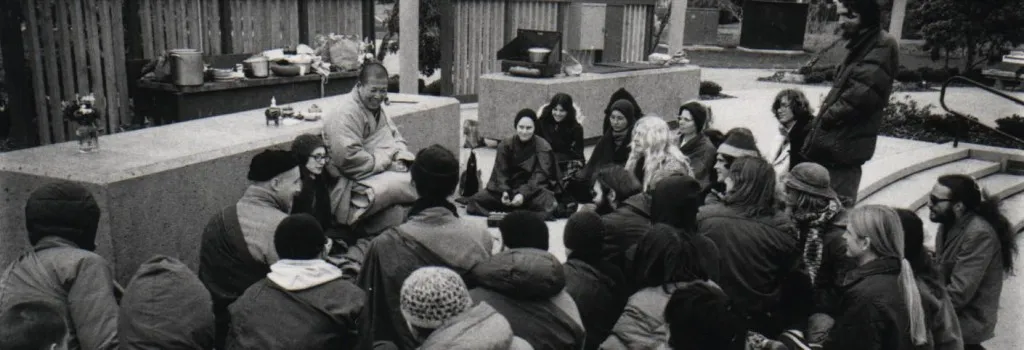
Venerable Master Hsuan Hua with disciples

Early life

Hsuan Hua was born Bai Yushu in 1918, the youngest of eight children in a rural family in Shuangcheng County, in the northeastern province of Jilin. His mother was a lifelong vegetarian who recited the name of Amitabha Buddha every day — a quiet practice that shaped her youngest son deeply.

He first encountered the reality of death at eleven, when he came across a dead infant lying on the ground. The sight stopped him. He searched and found the answers offered in the Buddha's teachings. At twelve he began bowing to his parents every morning and evening as an act of repentance — gradually extending this to all living beings, bowing over eight hundred times a day. He resolved to become a monk, but acquiesced to his mother's wish that he not do so while she was alive.

At fifteen he attended school for the first time. At sixteen he was already explaining the sutras to illiterate neighbours who wanted to hear the teachings. At eighteen he started a free school for around thirty poor children and adults, teaching as the sole instructor, and left school to care for his terminally ill mother. She passed away when he was nineteen.

Three years at the grave
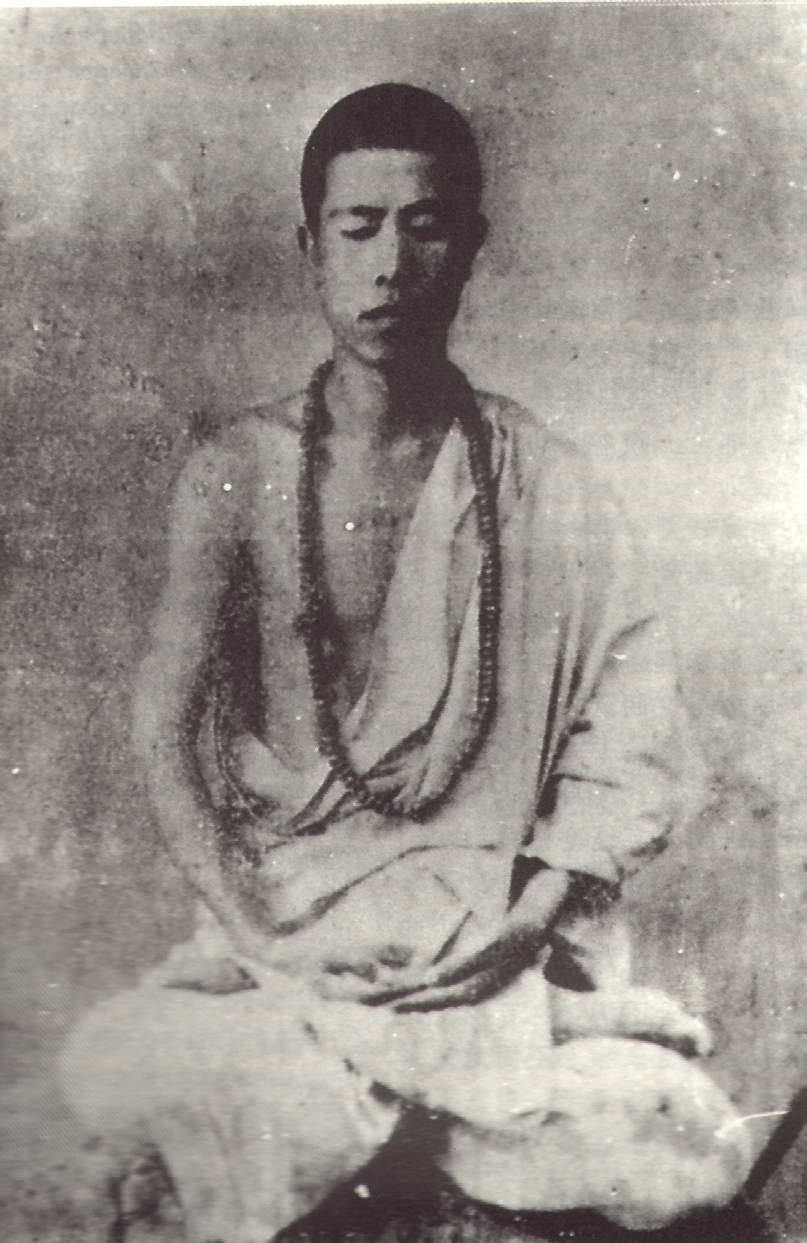
Master Hua in meditation, early period, Manchuria

After his mother's death, he travelled to Sanyuan Monastery in Harbin, where he took his novice ordination under Venerable Master Chang Zhi. He then built a small hut of sorghum thatch beside her grave and spent three years there in mourning and practice. He ate one meal a day and did not lie down to sleep at night. During those years he made eighteen great vows — vows that would govern the rest of his life. He read deeply in the sutras. It was while reading the Lotus Sutra that he experienced a profound awakening.

Later, seated in meditation, he had a vision of the Sixth Chan Patriarch, Huineng. In that vision, Huineng gave him a mission: to bring the Dharma to the Western world.

He was in his late teens, living in rural Manchuria. He had never been to the West. He spoke no English. He took the vision seriously.

At the end of those three years, he went into seclusion in Amitabha Cave in the Changbai Mountains, where he continued his practice in solitude. On his return he served as senior monk at Sanyuan Monastery in Harbin, remaining there until conditions drew him south.

Nanhua Monastery and Master Xuyun

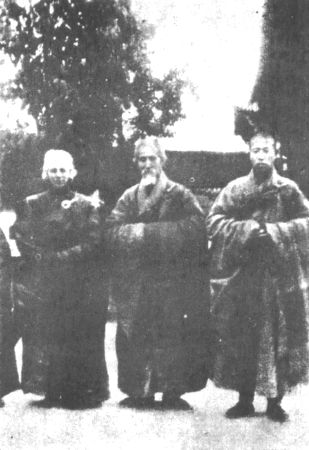
Young Master Hua with Elder Master Xuyun at Nanhua Monastery, 1948

In 1946, wanting to meet China's most revered living Chan master, he began the long journey south — an arduous passage of over two thousand miles across a country in the final years of civil war. He received full monastic ordination at Putuoshan in 1947.

In 1948 he arrived at Nanhua Monastery in Guangzhou, where he bowed before Master Xuyun — Empty Cloud — widely regarded as the greatest Chan master of the twentieth century. Master Xuyun had been born in 1840. He had lived through the fall of the Qing dynasty, two world wars, and the revolution. He was, by that point, over a hundred years old, and still teaching.

Xuyun appointed him head of the Vinaya Academy, and later Dean of Academic Affairs, and formally recognised in the young monk a genuine realisation.

Hong Kong

In 1949 he left for Hong Kong, where he spent over a decade teaching, sponsoring the printing of sutras, and building monasteries — Western Bliss Gardens, Cixing Chan Monastery, and the Buddhist Lecture Hall. He supported monastic refugees arriving from mainland China, and made several visits to Thailand and Burma to study the Theravada tradition firsthand.

In 1956, Xuyun transmitted to him the Dharma lineage of the Weiyang school of Chan — one of the five great schools of Chinese Buddhism — along with the name Hsuan Hua, meaning "to proclaim and transform." Master Hua became the forty-fifth generation holder of that lineage, traced back to the First Patriarch Mahakashyapa. He waited for the conditions in the West to ripen.

The monk in the grave
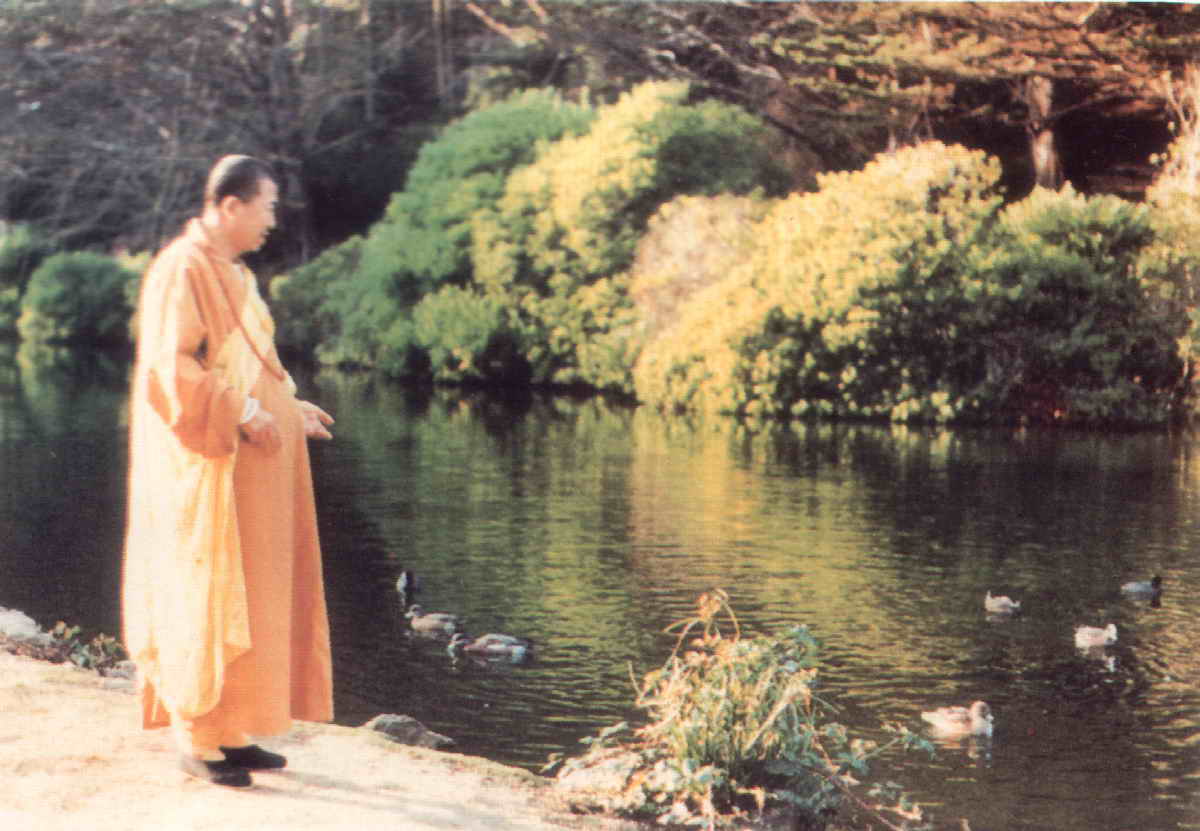
Master Hua by a pond in San Francisco, early 1960s

In 1962, invited by disciples who had settled in San Francisco, he flew to the United States — stopping over in Japan and Hawaii. He arrived in a country where almost no one knew what a Buddhist monk was, let alone what the sutras contained.

He began lecturing at the Buddhist Lecture Hall in Chinatown, which his disciples had already established as a branch of his Hong Kong hall. He held a public meditation hour every evening from seven to eight. He gave Dharma talks in Chinese. Early lectures were rendered into English by whoever was present who could manage it — imperfectly, haltingly, but earnestly. The Master was deeply patient. He taught daily, regardless of how many came.

In October 1962, as the Cuban Missile Crisis brought the United States and Soviet Union to the brink of nuclear war, the Master undertook a total fast of thirty-five days, praying for an end to the hostilities and for world peace.

In 1963 he moved to a first-floor flat on the corner of Sutter and Webster Streets in the Fillmore District and lived there in relative seclusion for five years. Because the flat was damp and windowless, he called himself "the monk in the grave" — and wrote a short poem about it:

Each of you now meets a monk in the grave.
Above there is no sun and moon, below there is no lamp.
Affliction and enlightenment — ice is water.
Let go of self-seeking and become apart from all that is false.

The summer that changed things

In the summer of 1968, more than thirty students from the University of Washington came down to San Francisco to attend an intensive study session on the Shurangama Sutra. The Master lectured through the entire text. At the end of the session, five of the young Americans asked permission to leave the home life and become monastics under his guidance.

It was the first time a novice monastic ordination had taken place on Western soil.

In 1969, those five — three men and two women — were sent to Taiwan for full ordination. The monastic community there was astonished. They were the first Americans to receive full Buddhist ordination in that era. News of it spread. People began to understand that something real was happening in California.

What he built

Over the following decades, the Master lectured on the sutras nearly every day. He founded Gold Mountain Monastery in San Francisco's Mission District in 1970, and in 1976 established the City of Ten Thousand Buddhas in Ukiah, California — one of the first traditional Chan monasteries in the Western world, and still the headquarters of the Dharma Realm Buddhist Association today.

He founded Dharma Realm Buddhist University and schools for children. He established the Buddhist Text Translation Society, which has since published more than a hundred volumes of translated sutras with his commentaries — the Buddhist canon rendered carefully into English, Vietnamese, Spanish, and other languages. The work of translation fell to his disciples, working together under his direction; it was a collective undertaking that continues to this day.

He trained hundreds of monastics, both Asian and Western, who now teach at monasteries and temples across the United States, Canada, Australia, Europe, and Asia. Gold Coast Dharma Realm is among them.

How he taught
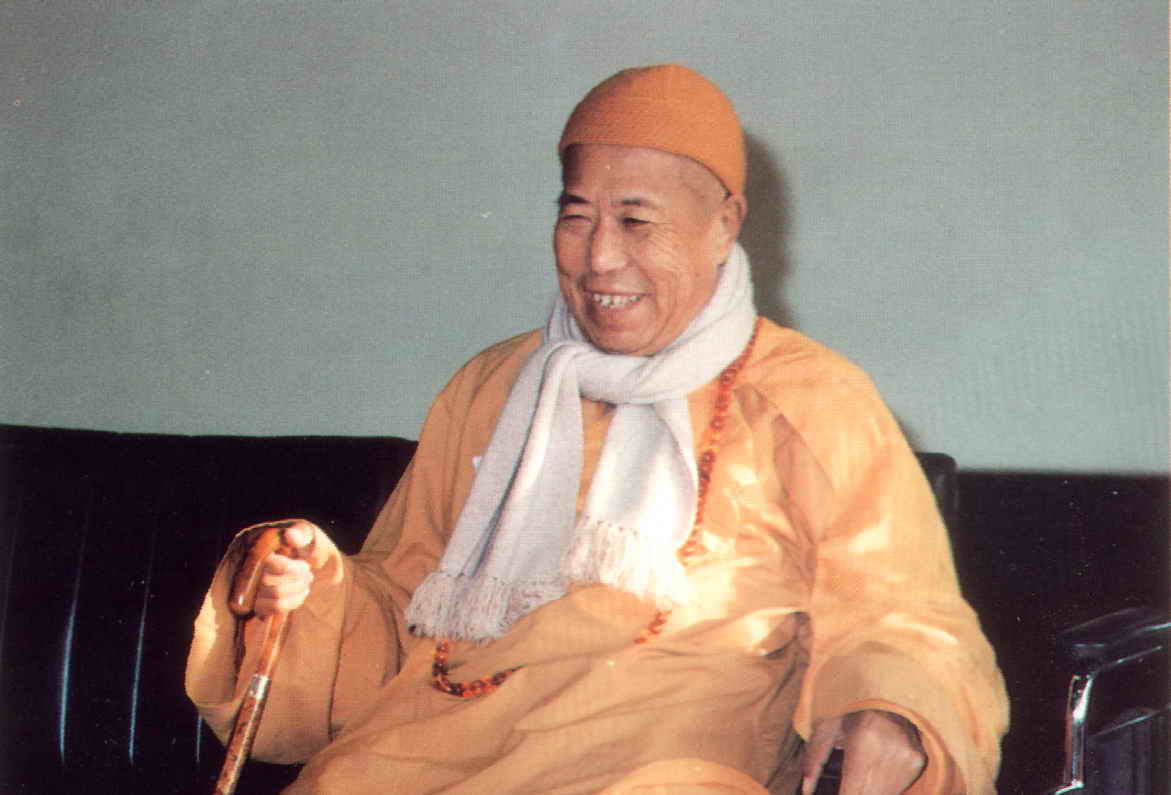
Venerable Master Hsuan Hua in later life

The Master lectured in Chinese. From 1968 to the early 1990s he gave sutra lectures at least once a day, and travelled extensively — to Hong Kong, Taiwan, India, Southeast Asia, and Europe. He was invited to speak at universities and academic conferences. His presence drew a multitude of the faithful wherever he went.

He held to strict practice himself: one meal a day, no lying down to sleep, the full monastic precepts kept without compromise. He expected the same of his monastic disciples. He was not a figure of easy comfort, but many who encountered him described something harder to name — a quality of presence, of complete attention, as though he saw the person in front of him clearly.

He was also a pioneer in bringing Buddhist traditions together — inviting Theravada monks to teach and share ordination duties alongside his own community, at a time when such exchange was uncommon.

He entered stillness on 7 June 1995 in Long Beach, California. His cremation yielded śarīra — crystalline relics that are a sign of deep practice.

A documentary biography

"From emptiness I came; to emptiness I am returning."

Venerable Master Hsuan Hua